An Edge-of-Field Technique For Nitrate Removal
Algal blooms are the result of the abundance of nitrogen and phosphorous in waters. These blooms deplete the oxygen in the water killing fish and marine life. Some also produce toxins in fresh water lakes. Unfortunately, agriculture contributes to the production of algal blooms because excess fertilizer leaches into the surface waters.
A simple material can remove excess nitrate from water: Woodchips! Woodchips can help create the ideal condition for the breakdown of nitrogen to nitrogen gas, a process called denitrification, and can be easily utilized. Below, I describe how woodchips are placed in “bioreactors” for nitrate removal.
For bioreactor construction, soil is excavated next to the outlet of a tile line. The hole is then filled with woodchips and covered with soil. Water is then diverted to the bioreactor.
At the inflow and outflow of the bioreactors, water structures are used to maintain the water level and allow monitoring of bioreactor’s performance.

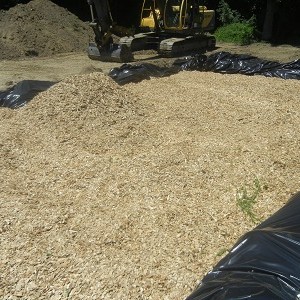
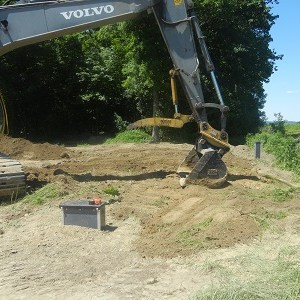

Bottom: Bioreactor profile
Small bioreactors may not remove nitrate efficiently. On the other hand, big bioreactors are expensive and have adverse environmental impacts. In a study [link to article] published in the Journal of Environmental Management, my colleagues and I discussed bioreactor design optimization.
Our long-term study on six bioreactors at three sites allowed a comprehensive investigation of the performance of the denitrifying bioreactors. We demonstrated that hydraulic retention time, temperature, influent nitrate concentrations, and organic matter availability influenced nitrate removal. In fact, at each field site and at two overall temperature levels, a linear relationship existed between the nitrate removal efficiencies and hydraulic retention times. Due to varied hydrological properties and influent nitrate concentrations at different sites, a single comprehensive relationship between retention time and nitrate removal did not govern all the bioreactors.
Woodchips bioreactors offer additional benefits such as pesticide removal, especially if they are amended with organic adsorbents. In another study [link to article] , we showed how biochar amended bioreactors removed atrazine.

