Preferential flow is the fast transport of water and solutes through a small fraction of soil. When preferential flow occurs in soils, surface contaminants don’t find a chance to adsorb to soil particles or degrade. Therefore, preferential flow is responsible for the contaminant flow to shallow groundwater and tile drains and drinking water wells and surface waters. There are two common types of preferential flow; one happens through structural cracks, wormholes, and root holes and is called macropore flow. The other happens because of sediment orientation and is called fingered flow. Below, you can find a brief description of each and the resources for further study.
Macropore flow
Macropore flow happens through macropores such as cracks, root holes, and wormholes. After a rainfall or irrigation, water encounters less resistance flowing through the macropores. Along with water, fertilizers and pesticides, that are applied to the topsoil, move to shallow groundwater or tiles. Since groundwater is the main source of drinking water in rural areas, macropore flow represents a challenge. Thus, it is crucial to determine how much contaminants reach groundwater.

Schematics of the flow of water through preferential flow in soil
Traditionally, solute transport models assume a uniform water flow in soils. This is partially because of the complicated physics of preferential flow which made it hard to model. In a paper [link to article] published in the Vadose Zone Journal, my colleagues and I described preferential transport of pesticides using a simple model that considered different transport pathways.
This model first divides the soil profile into two zones; a top distribution zone where a uniform mixing of the solute within soil occurs, and a bottom conveyance zone where preferential flow occurs. The distribution zone acts as a linear reservoir that exponentially delivers the chemicals to the conveyance zone. The model allows two or more parallel flow domains in the conveyance zone. In each flow domain, the convective-dispersive equation was used to describe the transport of pesticides.
The advantage of application of PFM is its minimal data requirement and simple description of preferential flow. In addition, this model uses an analytical solution for the convection-dispersion equation.
Fingered flow
Another type of preferential flow happens when an unstable wetting front is created in layered soil with a fine-texture top layer and a coarser subsoil. In such cases, water flows in the dry, coarse sand through narrow wetting columns that resemble fingers. Thus, this phenomenon is called fingered flow.
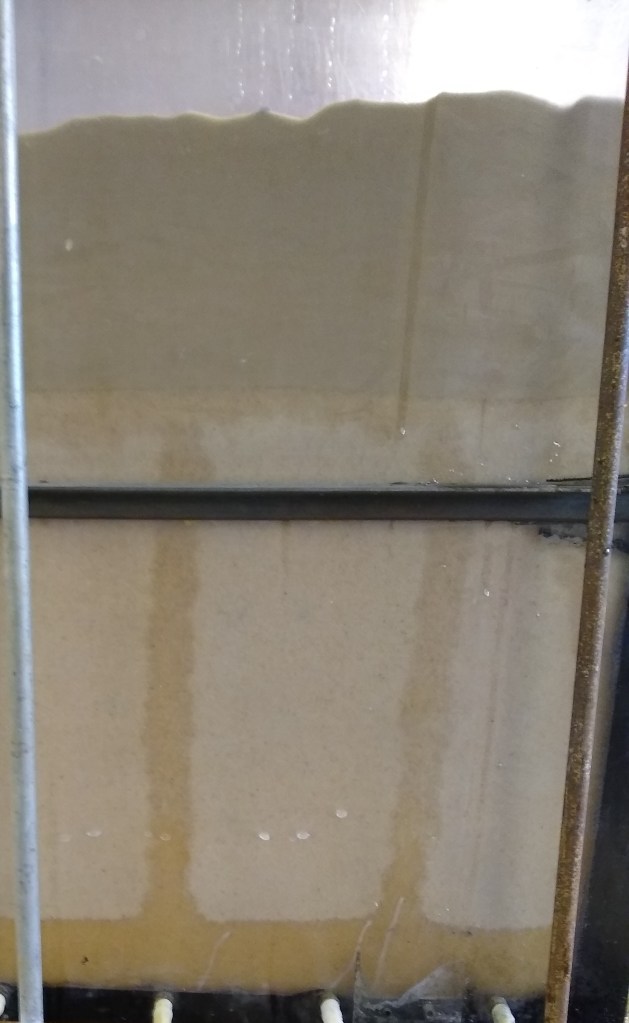
Demonstration of fingered flow occurrence in a Hele Shaw Cell
At the tip of the fingers, the size of the water meniscus increases until the water breaks from one pore to the next. Thus, water flows in one pore at a time, and the wetting front is discontinuous. With this challenging physics, one-dimensional conventional models fail to describe the fingered flow. In a research [link to article], first-authored by professor Steenhuis, we described the capillary pressure at the tip of the fingers using contact angle.
Additional Resources:
Soil and water lab at Cornell University, provides ample information about preferential flow and modeling.
Vadose Zone Journal is an open-access scientific journal that focuses on soil studies, especially water and solute transport. This journal published a special section on preferential flow in 2010.

