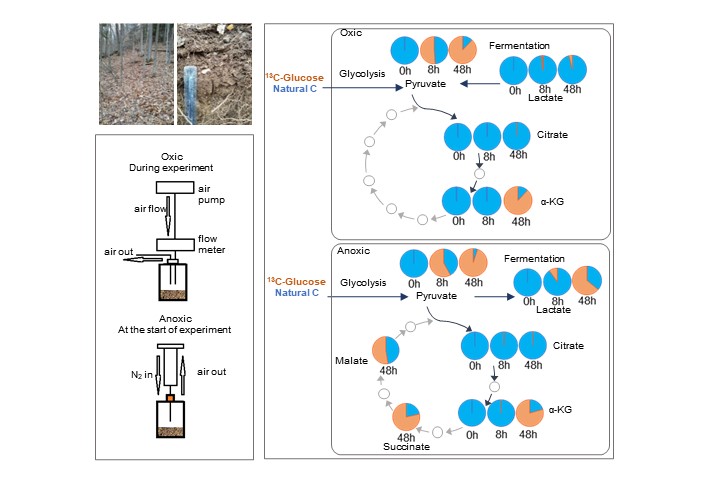
In a recent study [link to article], we tracked the sequential incorporation of 13C from 13C-glucose in short-chain carboxylic acids under oxic and anoxic conditions in soils. Traditionally, investigating soil microbial activity has relied on measuring CO2 emissions as a proxy for microbial metabolism. However, measuring CO2 does not fully capture soil metabolic activities and the transformation of organic matter in soils.
Short-chain carboxylic acids are secreted by microorganisms and can be an indicator of redox conditions. Our study measured the abundance and isotopic enrichment of short-chain carboxylic acids in soils incubated under oxic and anoxic conditions.
We made several interesting observations: (1) Under anoxic conditions, there was an accumulation of organic acids, an indicator of metabolic overflow, and a signature of anaerobic conditions. (2) Lactate, a product of the fermentation pathway, was secreted under anoxic conditions, but its concentration decreased under oxic conditions, implying it served as a carbon source.
In addition, by employing this approach, we also captured soil priming. Soil priming refers to the increased microbial activity after adding organic substrate to the soil, leading to the advanced decomposition of soil insoluble and recalcitrant organic matter. This research opens the door to further studies for the investigation of soil organic matter cycling and its relationship to the cycling of other nutrients.
 Bahareh Hassanpour