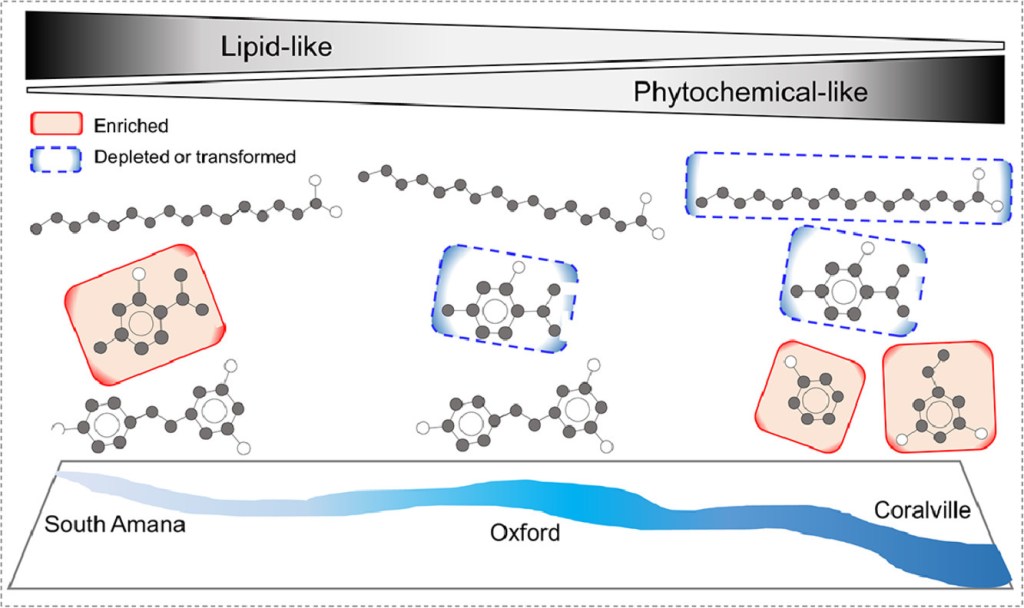
In our study, we developed a framework for compound identification and characterization using liquid chromatography-high-resolution mass spectrometry combined with metabolomics approaches. Using this approach, we identified specific groups of compounds and determined their variations along a stream in an agricultural watershed impacted by agricultural, natural, and urban environments.
We combined our high-resolution metabolomics grouping with traditional stoichiometric characterization to unravel the variability of dissolved organic matter. We uncovered patterns in the molecular features of the DOM composition that were unresolved by stoichiometric ratios in the chemical formulae. For instance, the stoichiometric analysis implied increased aromaticity from upstream to downstream sites, and our metabolomics analysis specified an increased abundance of flavonoids and phenylpropanoids, two important subgroups of aromatic compounds. The stoichiometric analysis also proposed a location-specific decrease in the abundance of lipid-like compounds, which were attributed specifically to medium-chain and short-chain fatty acids; other lipids, such as long-chain fatty acids and sterol lipids, remained unchanged. In sum, the metabolomics analysis of the chemical formulae resolved molecular variability in the stoichiometric DOM composition to illustrate molecular subgroups underlying carbon transport and cycling dynamics in the stream.
 Bahareh Hassanpour