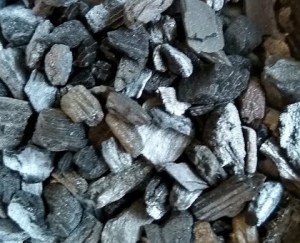
Biochar is a product of the pyrolysis of biomass under oxygen-deprived conditions. Composed of aromatic compounds, biochar has shown the capability to remove organic compounds. Therefore, in a study [link to article]1, we utilized it to improve atrazine removal in woodchip denitrifying bioreactors. Atrazine and nitrate are co-present in agricultural drainage waters as they both are applied on agricultural fields, often at the same time. Therefore, it is important to remove them both.
Atrazine is the second most commonly used herbicide in the United States 2, and is moderately mobile in soil. Applied to agricultural land, atrazine percolates to shallow groundwater and into agricultural tile lines mainly through preferential pathways 3-6. Atrazine’s use is banned in the European Union due to its widespread contamination of groundwater 7. However, it is still used in the United States, where it is found in groundwater throughout the year, especially in agricultural areas. Atrazine adversely impacts the ecological health by its negative effects on humans, other mammals and aquatic life 8.
We experimented with laboratory denitrifying bioreactors, where we used woodchip denitrifying bioreactors and woodchip+ biochar bioreactors. Our finding showed that the amendment of woodchips bioreactors with biochar improved atrazine removal by 40%, and in only 72h, 95% of atrazine was removed in biochar amended bioreactors. We also showed that the removal of atrazine occurred primarily via adsorption, although degradation had also occurred. Our laboratory experiment demonstrated that denitrifying bioreactors, especially with biochar amendment, can simultaneously removenitrate and pesticide transport from agricultural lands to surface waters.
Would you like to know how biochar impacts nitrate removal? Well, the answer is not simple. We showed in a recent study [link to article] that fresh biochar can increase denitrification because it adsorbs oxygen from water and provides the anaerobic conditions needed for denitrification. However, aged biochar that already adsorbed oxygen may slightly reduce denitrification 9.
References
1. Hassanpour, B., L.D. Geohring, A. R. Klein, S. Giri, L. Aristilde, and T.S. Steenhuis. (2019). Application of denitrifying bioreactors for the removal of atrazine in agricultural drainage water. Journal of Environmental Management, 239(1), 48-56
2. Atwood D, Paisley-Jones C. Pesticides Industry Sales and Usage; 2008-2012 Market Estimates.; 2017.
3. Rothstein E, Steenhuis TS, Peverly JH, Geohring LD. Atrazine Fate on a Tile Drained Field in Northern New York: A Case Study. Agric Water Manag. 1996;31(3):195-203. doi:10.1016/0378-3774(96)01250-4
4. Steenhuis TS, Staubitz W, Andreini MS, et al. Preferential Movement of Pesticides and Tracers in Agricultural Soils. J Irrig Drain Eng. 1990;116(1):50-66. doi:10.1061/(ASCE)0733-9437(1990)116:1(50)
5. Warnemuende EA, Patterson JP, Smith DR, Huang C. Effects of Tilling No-till Soil on Losses of Atrazine and Glyphosate to Runoff Water Under Variable Intensity Simulated Rainfall. J Soil Tillage Res. 2007;95:19-26. doi:10.1016/j.still.2006.09.001
6. Shipitalo MJ, Malone RW, Ma L, et al. Corn stover harvest increases herbicide movement to subsurface drains – Root Zone Water Quality Model simulations. Pest Manag Sci. 2016;72(6):1124-1132. doi:10.1002/ps.4087
7. Sass JB, Colangelo A. European Union Bans Atrazine, While the United States Negotiates Continued Use. Int J Occup Environ Health. 2006;12(3):260-267. doi:10.1179/oeh.2006.12.3.260
8. Graymore M, Stagnitti F, Allinson G. Impacts of Atrazine in Aquatic Ecosystems. Environ Int. 2001;26(7-8):483-495. doi:10.1016/S0160-4120(01)00031-9
10. Hassanpour, B., Riazi, S.F., Menzies Pluer, E.G., Geohring, L.D., Guzman, C.D., Steenhuis, T.S., (2020). Biochar acting as an electron acceptor reduces nitrate removal in woodchip denitrifying bioreactors. Ecological Engineering, 149, 105724
 Bahareh Hassanpour